Why String Theory?
Some reflections on why string theory is worth the trouble, plus a brief history and a handful of highlights.
Every learner of string theory eventually has to answer one question for themselves: why bother? The subject is notoriously hard to learn, it still lacks a complete non-perturbative definition, and after more than fifty years it has made no direct contact with experiment. So why spend years on it?
This post is my attempt to write that answer down — along with a quick tour of where the theory came from and what it actually says. I should say up front that I am a learner rather than an expert, so read this as one person’s motivation rather than a survey.
A note on how to read this. I’ve tried to write it so the main thread makes sense without a physics background, and tucked the technical material into expandable boxes that look like this:
What's in a box like this
The details a specialist would want and a casual reader can skip — derivations, caveats, and the places where the standard one-line story isn’t quite right. Skipping every box still leaves a complete argument.
There’s also a glossary at the end for the recurring jargon.
The short version
If you read nothing else, here it is.
Our two best theories of nature don’t fit together. Quantum mechanics describes everything small; general relativity describes gravity and everything large. Try to combine them directly and the mathematics stops giving sensible answers at very small distances.
String theory’s proposal is that the fundamental objects aren’t points but tiny vibrating strings, and that every particle is a different note the same string can play. This one change cures the mathematical breakdown. The price is steep: the theory only works in ten dimensions, so six of them have to be curled up too small to see.
Nobody knows whether this describes our universe. There is no experimental evidence for it, and probably won’t be soon. But in the course of trying to make it work, physicists accidentally derived where a black hole’s entropy comes from, discovered that gravity in a region can be equivalent to a gravity-free theory on its boundary, built calculational tools now used in nuclear and condensed matter physics, and handed mathematicians several results they would have been glad to have anyway.
That accidental harvest, more than any single prediction, is why people stay.
The rest of this post is the long version.
Why do we bother?
A consistent theory of quantum gravity
The oldest reason is still the deepest one. The Standard Model describes the electromagnetic, weak, and strong interactions as quantum field theories, while gravity remains classical, described by general relativity.
It’s worth being precise about what “quantizing gravity doesn’t work” means, because the usual one-line version overstates it. Treated as an effective theory — one that admits it only applies below some energy — quantized general relativity is perfectly well-behaved at low energies and even yields honest quantum corrections to the Newtonian potential (Donoghue, 1994). The problem is ultraviolet, meaning it shows up at very short distances and high energies. There, curing the infinities requires an infinite tower of correction terms, each with a coefficient no experiment could ever fix. The theory doesn’t become nonsense — it becomes unpredictive at the Planck scale, which for a fundamental theory amounts to the same thing.
Where exactly gravity's divergences appear
Pure gravity happens to be finite at one loop (’t Hooft & Veltman, 1974), which was briefly encouraging. The two-loop divergence is real (Goroff & Sagnotti, 1986), and coupling gravity to matter already spoils things at one loop.
The structural reason is that Newton’s constant is dimensionful. Each order in perturbation theory therefore requires counterterms of ever-higher dimension, and non-renormalizability means their coefficients aren’t fixed by finitely many measurements. As an effective field theory this is fine — the unknown coefficients are suppressed by powers of $E/M_{\text{Pl}}$ — but it tells you nothing about the Planck scale itself.
String theory attacks this by replacing point particles with extended, vibrating strings. A one-dimensional object sweeps out a two-dimensional surface as it moves, and on that surface there is no distinguished interaction point: what looks like a splitting vertex to one observer is smeared elsewhere for another. The point-like collision of propagators that generates the infinities in field theory simply has no analogue.
Two honest caveats about finiteness
Both are usually glossed over, and both matter.
- For closed strings, the sharper reason for finiteness is modular invariance. The would-be UV region of the moduli integral is a copy of the IR region, so restricting to the fundamental domain removes it entirely — there is no UV region left to diverge in. The divergences that do survive are infrared, and they have ordinary physical interpretations (massless tadpoles, mass renormalization).
- Order-by-order finiteness of superstring perturbation theory is not the trivial statement it is sometimes made out to be. Putting it on a firm footing required careful treatment of supermoduli and the Ramond sector, worked out relatively recently (Witten, 2012; Sen, 2015).
I also want to be fair to the alternatives. Asymptotic safety, loop quantum gravity, and causal dynamical triangulations are all live programs. What distinguishes string theory, as far as I can tell, is that it hands you a concrete, calculable prescription for how gravitons scatter, order by order, inside a framework rigid enough that consistency alone fixes the number of spacetime dimensions and the allowed symmetry groups.
Takeaway: the trouble with quantum gravity isn’t that we can’t quantize it at all — it’s that we lose all predictive power at short distances, and extended objects are one way not to.
What fell out along the way
What convinces me the framework is more than a clever trick is how much it produced that nobody was aiming for.
Black hole thermodynamics (Bekenstein, 1973; Bardeen, Carter & Hawking, 1973; Hawking, 1975) assigned black holes an entropy proportional to the area of the horizon. In every other context, entropy counts microscopic arrangements — the number of ways to shuffle a system’s parts without changing how it looks from outside. For black holes there was nothing to count. Strominger and Vafa (1996) supplied the missing objects: for a certain idealized black hole, counting configurations of D-branes reproduces exactly the entropy thermodynamics had demanded, factor of $1/4$ and all.
How much the idealization matters
The black hole in question is supersymmetric and extremal, in five dimensions. The counting is done at weak coupling, where the branes are tractable, and then compared against the geometry at strong coupling, where the black hole exists. What licenses that comparison is supersymmetry: the states being counted are BPS, so their degeneracy is protected as the coupling is dialed up.
This is why the result is a genuine derivation and also not yet a statement about the black hole at the centre of the galaxy. It has since been pushed to near-extremal cases and to subleading corrections in the entropy, but the fully generic case remains open.
The area scaling of entropy also motivated the holographic principle (’t Hooft, 1993; Susskind, 1995): everything happening inside a region of space should be encodable on its boundary, the way a flat piece of film can store a three-dimensional scene. AdS/CFT (Maldacena, 1997) turned that slogan into a working framework by conjecturing that gravity inside a particular kind of spacetime is exactly equivalent to a quantum field theory — with no gravity in it at all — living on the boundary. The dictionary translating between the two sides was made precise shortly afterwards (Gubser, Klebanov & Polyakov, 1998; Witten, 1998).
That reframed the information paradox (Hawking, 1976). Hawking had argued that black holes destroy information, which quantum mechanics forbids. But if the boundary description is an ordinary quantum theory, and ordinary quantum theories don’t destroy information, then evaporation must preserve it — and the question becomes how rather than whether.
Answering the “how” took another twenty years and went through entanglement. The Ryu-Takayanagi formula (Ryu & Takayanagi, 2006) computes how entangled two halves of the boundary theory are by measuring the area of a surface in the interior — tying the shape of spacetime to quantum information closely enough that people began arguing geometry is built from entanglement (Van Raamsdonk, 2010). Applying the refined version to an evaporating black hole then reproduced the Page curve directly from a gravity calculation (Penington, 2019; Almheiri et al., 2019): the entropy of the outgoing radiation rises, turns over, and falls, exactly as information conservation requires.
The technical thread, in order
Ryu-Takayanagi computes the entanglement entropy of a boundary region as the area of the bulk minimal surface homologous to it, later covariantized for time-dependent settings (Hubeny, Rangamani & Takayanagi, 2007). Including bulk quantum fields promotes this to the quantum extremal surface prescription.
Page’s argument (1993) was that unitary evaporation forces the radiation entropy to peak at roughly half the black hole’s lifetime and then decrease, whereas Hawking’s calculation gives monotonic growth. The 2019 work showed that the quantum extremal surface jumps at the Page time to a new saddle — one that includes a disconnected “island” of the black hole interior in the entanglement wedge of the radiation — reproducing the turnover. What this implies about the underlying microphysics is still actively debated.
None of this was on anyone’s agenda in 1974. It fell out of trying to make sense of the theory.
Takeaway: string theory’s most valuable outputs so far have been byproducts — answers to questions about black holes and information that nobody set out to answer.
A ridiculously rich structure
The second thing that keeps me interested is how generative the theory is. There are exactly five consistent superstring theories in ten dimensions, plus M-theory underlying them — and yet by curling up the extra dimensions in different shapes and adding branes in different arrangements, this small handful “engineers” what feels like an endless supply of quantum field theories in various dimensions, many of them strongly coupled and otherwise inaccessible.
Then there is duality: the discovery that descriptions which look nothing alike can be the same physics. A subway map and a street map of the same city are both correct, neither is more fundamental, and each makes a different set of questions easy to answer. Dualities are like that, except the two maps can disagree about how many dimensions the city has.
The five string theories are stitched together by a web of such relations, and AdS/CFT is itself a duality of this kind — the extreme case. What makes them so useful is that a calculation which is hopeless on one side is often routine on the other.
The main dualities, concretely
T-duality relates a string on a circle of radius $R$ to one on a circle of radius $\alpha’/R$, exchanging momentum modes with winding modes. It implies there is a smallest meaningful distance: shrinking a dimension below the string scale gives back a theory you already had.
S-duality exchanges strong and weak coupling, $g_s \leftrightarrow 1/g_s$, mapping perturbative states to solitonic ones. Type IIB is self-dual under it; Type I and $SO(32)$ heterotic are exchanged.
Mirror symmetry relates compactifications on topologically distinct Calabi-Yau manifolds, exchanging their complex structure and Kähler moduli.
Combining T- and S-duality generates the U-duality groups, and the figures below show how the resulting web hangs together.
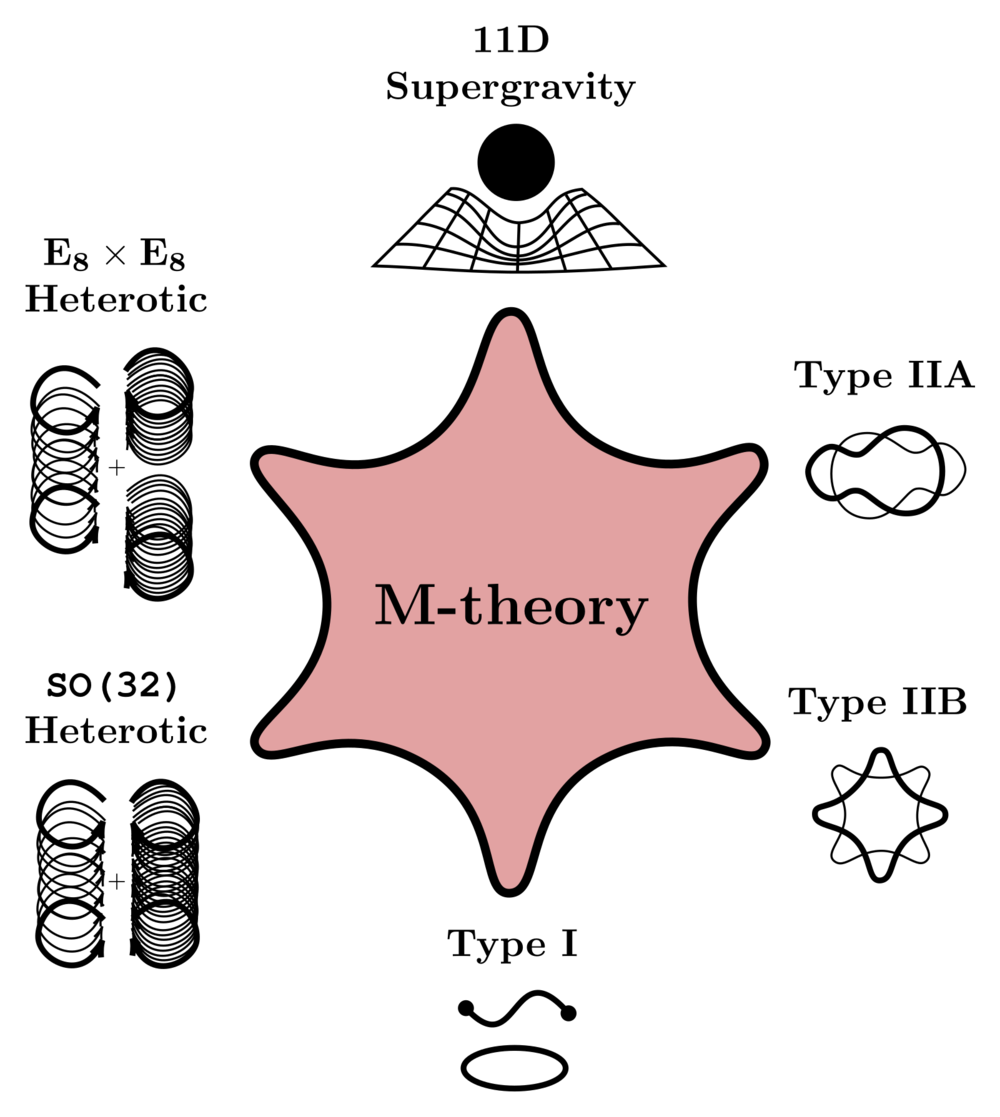
All five ten-dimensional superstring theories, together with eleven-dimensional supergravity, arise as different limits of a single underlying M-theory. Figure from (Nawata, Tao & Yokoyama, 2022).

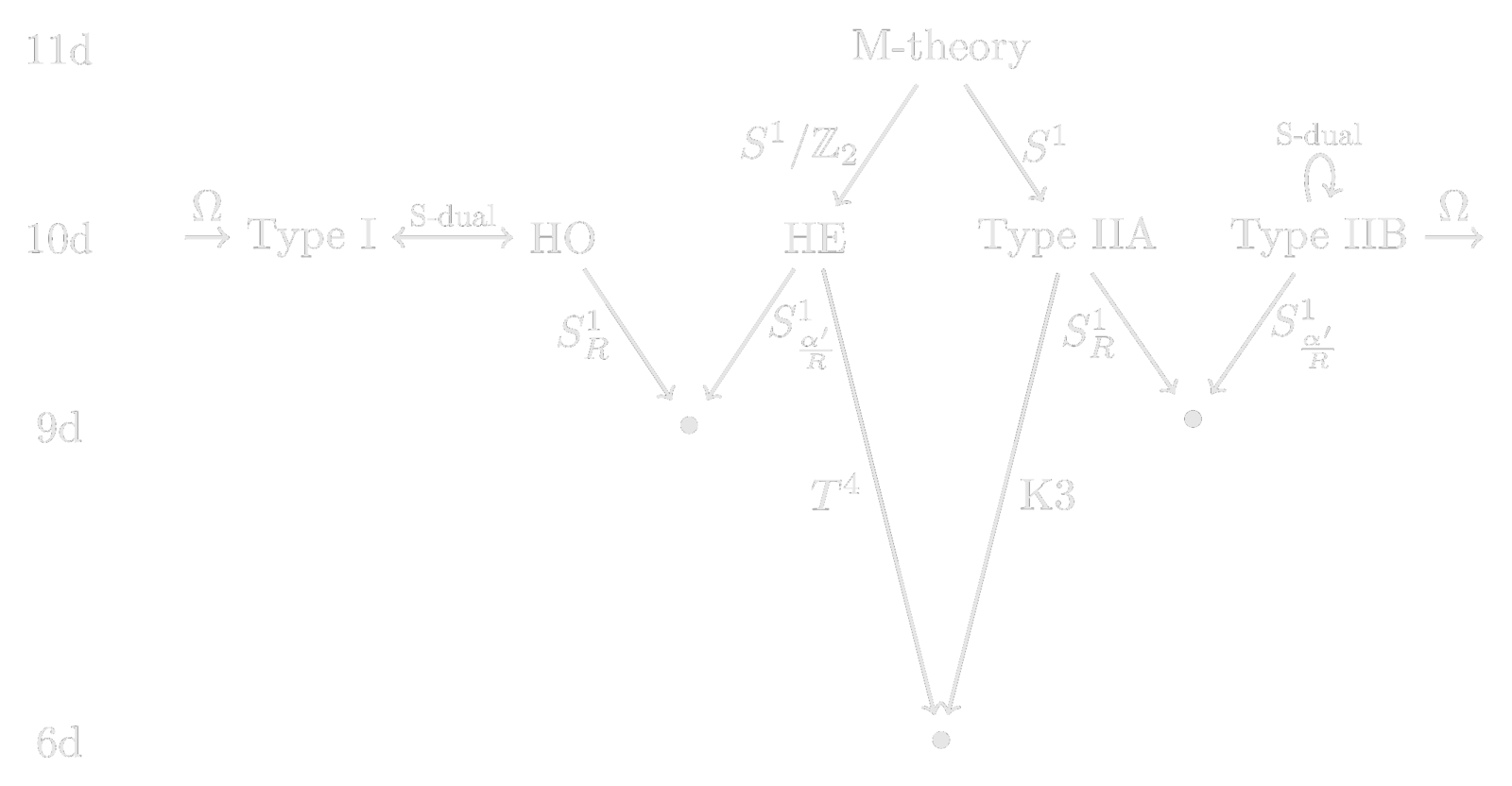
A more detailed version of the same web, showing the specific compactifications — circles, orbifolds, $K3$, $T^4$ — that relate the theories to one another. Figure from (Nawata, Tao & Yokoyama, 2022).
Takeaway: a handful of theories, related by dualities, generates an enormous variety of physics — and each duality turns some intractable problem into a tractable one.
A toolkit for strongly coupled physics
There is also a reason that has nothing to do with whether string theory describes our universe.
Most of physics is done by perturbation theory: assume the interactions are weak, then correct a simple answer step by step. When interactions are strong — inside a proton, inside certain exotic metals — that method fails, and there aren’t many replacements. Holography supplies one. Translate the hard, strongly coupled problem into its gravitational dual, where it becomes an ordinary geometry problem, and solve it there instead.
The best-known example concerns how “runny” a fluid is. Any strongly coupled plasma with a gravity dual has a shear-viscosity-to-entropy-density ratio of $\eta/s = 1/4\pi$ (Kovtun, Son & Starinets, 2005) — remarkably low, meaning the fluid flows almost without internal friction. The quark-gluon plasma produced in heavy-ion collisions at RHIC and the LHC turns out to sit near that value, and far from what weak-coupling methods predict. Similar constructions have been used to model superconductors (Hartnoll, Herzog & Horowitz, 2008), non-Fermi liquids, and quantum quenches.
I want to be careful not to oversell this. $\mathcal{N} = 4$ super Yang-Mills is not QCD, and holographic models of condensed matter systems are models, not derivations. But “here is a controlled calculation in a strongly coupled theory that shares the right symmetries” is a genuinely scarce commodity in physics, and it came out of a theory of quantum gravity.
Takeaway: even if string theory turns out not to describe our universe, holography has already become a working tool in fields with nothing to do with quantum gravity.
New mathematics, as a side effect
I didn’t come to physics through mathematics, but string theory drags you toward it anyway.
Mirror symmetry (Greene & Plesser, 1990; Candelas et al., 1991) is the cleanest example. Geometers had a hard counting problem — how many curves of a given degree sit inside a certain six-dimensional space — that had resisted them for decades. Physicists, working on two string compactifications they expected to be physically equivalent, produced a formula answering it in one stroke, later proved correct by mathematicians. Its subsequent reformulations (Kontsevich, 1994; Strominger, Yau & Zaslow, 1996) reshaped how geometers think about these spaces.
Other cases where physics arrived first
- Seiberg-Witten theory (Seiberg & Witten, 1994) solved the low-energy dynamics of $\mathcal{N}=2$ gauge theory exactly. The associated equations gave invariants that transformed four-manifold topology (Witten, 1994), replacing much harder Donaldson theory computations.
- AGT (Alday, Gaiotto & Tachikawa, 2010) equates partition functions of four-dimensional gauge theories with conformal blocks of a two-dimensional theory — an equality between objects with no obvious reason to be related.
- Geometric Langlands. Electric-magnetic duality turned out to be a physical avatar of a deep program in representation theory (Kapustin & Witten, 2007).
None of these were things string theorists set out to prove. They appeared because the theory kept forcing questions about geometry that classical differential geometry alone couldn’t answer. Lorentzian geometry was enough for Einstein’s gravity; the geometric structures underlying string theory — derived categories, generalized geometry, non-geometric backgrounds — are still not fully worked out. That’s less a weakness than a sign there is real mathematical territory left to map!
Takeaway: the theory has repeatedly produced correct mathematics ahead of the proofs, which suggests it’s tracking something real even where it isn’t tracking our universe.
The honest reason: we still don’t fully understand it
Day to day, this is the reason that matters most. String theory is criticized, sometimes fairly, for the fact that even its practitioners cannot say what it is except as a perturbative expansion — a recipe for small corrections rather than a definition. But that is also precisely what makes it worth working on. A theory that was fully understood would have nothing left to give a learner; every result would already belong to someone else. A theory that isn’t understood yet means a genuinely small piece of progress can still be a real discovery. That is a strange kind of privilege, and not one I take for granted.
What the critics get right
It would be dishonest to write all of the above without acknowledging the other side, so briefly.
Curling up six dimensions can be done in a staggering number of ways, and adding fluxes to hold them in place (Giddings, Kachru & Polchinski, 2002; Kachru et al., 2003) multiplies the possibilities further. The usual estimate is around $10^{500}$ distinct vacua (Douglas, 2003). That number is hard to feel: the observable universe holds something like $10^{80}$ atoms, and you could square that twice over and still fall short. Each vacuum gives different four-dimensional physics, and there is no known principle picking out ours.
Without such a principle, “string theory predicts X” is a claim needing heavy qualification, and the standard complaint — that a framework accommodating almost anything cannot be tested — has real force.
The swampland program (Vafa, 2005; Ooguri & Vafa, 2007) is the most serious attempt to push back. Instead of selecting a vacuum, it asks the reverse question: which low-energy theories can never come from a consistent quantum gravity? That does yield real constraints, though how much of it is established rather than conjectural is itself contested.
I don’t think these criticisms are answered. I think they are reasons to work on the subject rather than reasons to leave it — but a reader should know they exist and weigh them.
Takeaway: the theory’s flexibility is its most serious problem, not a footnote to one.
A (very) brief history
String theory wasn’t invented to describe gravity; it was found by accident while people were doing something else.
Hadrons (1968–1973). Veneziano wrote down an amplitude (1968) that neatly reproduced a pattern seen in the debris of particle collisions — heavier particles spinning proportionally faster, $M^2 \propto J$. Within two years, Nambu, Nielsen, and Susskind independently recognized that this formula is exactly what you would get if those particles were tiny strings (Susskind, 1970), with quarks at the ends and heavier states corresponding to faster vibrations. The picture was elegant, but the discovery of asymptotic freedom in 1973 established QCD as the correct theory of the strong force, and the string program looked like a dead end.
The reinterpretation (1974). The spectrum contained a stubborn massless spin-2 state that nobody wanted for hadrons. Scherk and Schwarz (1974), and independently Yoneya (1974), proposed the obvious-in-hindsight move: a massless spin-2 particle is a graviton, so stop trying to describe hadrons and treat the theory as one of quantum gravity. The unwanted particle became the whole point. That reinterpretation pushed the characteristic string scale up by some twenty orders of magnitude, to the Planck scale.
Removing the tachyon (1971–1977). The early theory predicted a particle of imaginary mass — a tachyon, the signature of an unstable vacuum. Adding fermionic degrees of freedom to the worldsheet (Ramond, 1971; Neveu & Schwarz, 1971) gave the RNS superstring, but the tachyon survived; what actually eliminates it — and delivers spacetime supersymmetry as a bonus — is the GSO projection (Gliozzi, Scherk & Olive, 1977), a rule for consistently discarding half the states. The classification into Type I, IIA, and IIB came out of Green and Schwarz’s work over the following years.
First superstring revolution (1984). Anomalies are symmetries that hold classically but are destroyed by quantum effects; in a theory of gravity they are fatal. Green and Schwarz showed (1984) that the anomalies of ten-dimensional supergravity coupled to gauge fields cancel — but only for a very short list of symmetry groups, of which $SO(32)$ and $E_8 \times E_8$ have string realizations. Type I string theory realizes the first; the second motivated the construction of the heterotic strings (Gross, Harvey, Martinec & Rohm, 1985). Together with the observation that compactifying the heterotic string on a Calabi-Yau threefold yields something recognizably like four-dimensional particle physics (Candelas, Horowitz, Strominger & Witten, 1985), this set off a wave of interest that never really subsided.
Second superstring revolution (1995). Building on evidence for non-perturbative dualities (Hull & Townsend, 1994; Townsend, 1995), Witten proposed (1995) that all five ten-dimensional string theories are limits of a single eleven-dimensional theory, M-theory — five maps of one territory. In the same year Polchinski identified D-branes as the carriers of Ramond-Ramond charge (1995), which gave dualities a concrete handle and made the black hole entropy counting possible a year later. Maldacena’s AdS/CFT correspondence followed in 1997 — and, in a pleasing loop, brought string theory back to the strong interaction it had been invented to describe.
Branes (2007–present). Attention has increasingly shifted from strings to the branes themselves. The worldvolume theory of M2-branes turned out to be a Chern-Simons-matter theory, first through the Bagger-Lambert-Gustavsson construction (Bagger & Lambert, 2007; Gustavsson, 2009), which describes two M2-branes, and then in general through ABJM (Aharony et al., 2008). M5-branes have been far more stubborn: their worldvolume theory is the six-dimensional $\mathcal{N} = (2,0)$ theory (Witten, 1995b), which still has no known Lagrangian description — we can say a great deal about a theory nobody knows how to write down. Gaiotto’s work on wrapping M5-branes on Riemann surfaces (2009) opened up the “class $\mathcal{S}$” program, which remains very active. That is roughly where the frontier sits today, alongside the conformal bootstrap, amplitude methods, the swampland, and black hole information.
A rough timeline, with a standard textbook from around each era:
| Year | Milestone | Textbook of the era |
|---|---|---|
| 1968–70 | Veneziano amplitude; string interpretation of hadrons | |
| 1974 | Graviton identified in the string spectrum | |
| 1984 | First superstring revolution — Green-Schwarz anomaly cancellation | Green, Schwarz & Witten (1987) |
| 1995 | Second superstring revolution — M-theory, D-branes | Polchinski (1998) |
| 1997 | AdS/CFT correspondence | Zwiebach (2004) |
| 2007$\sim$ | M2-brane dynamics (BLG, ABJM) | Becker, Becker & Schwarz (2006); Kiritsis (2007) |
| 2010$\sim$ | M5-brane dynamics (Gaiotto and beyond) | Blumenhagen, Lüst & Theisen (2013) |
The point of the table is to place the standard references in time, not to be exhaustive — plenty of other books and lecture notes cover the same ground, and Tong’s notes are probably the gentlest entry point of all.
A few highlights
Stripped of the machinery, the physical content of the theory is fairly easy to state.
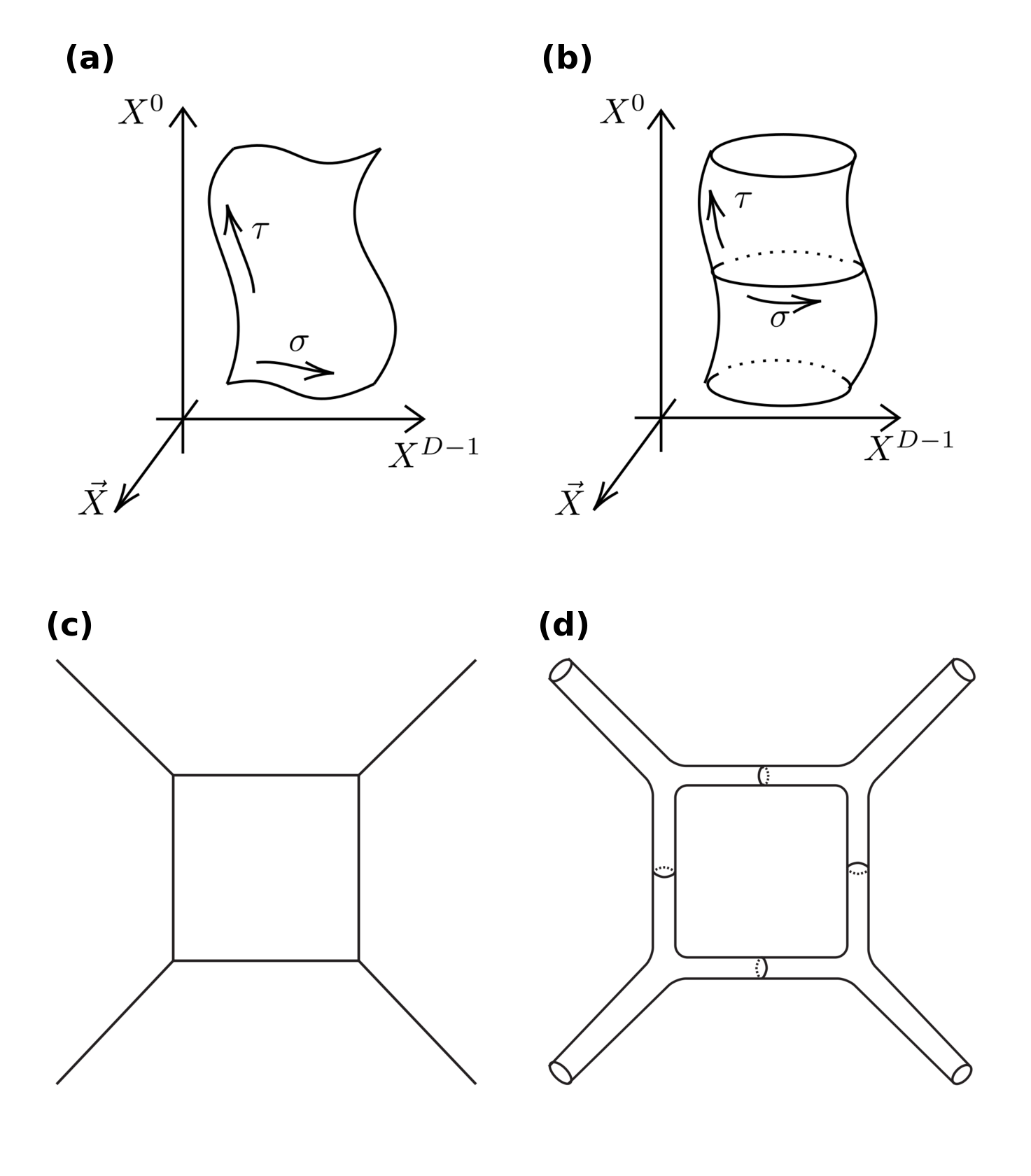
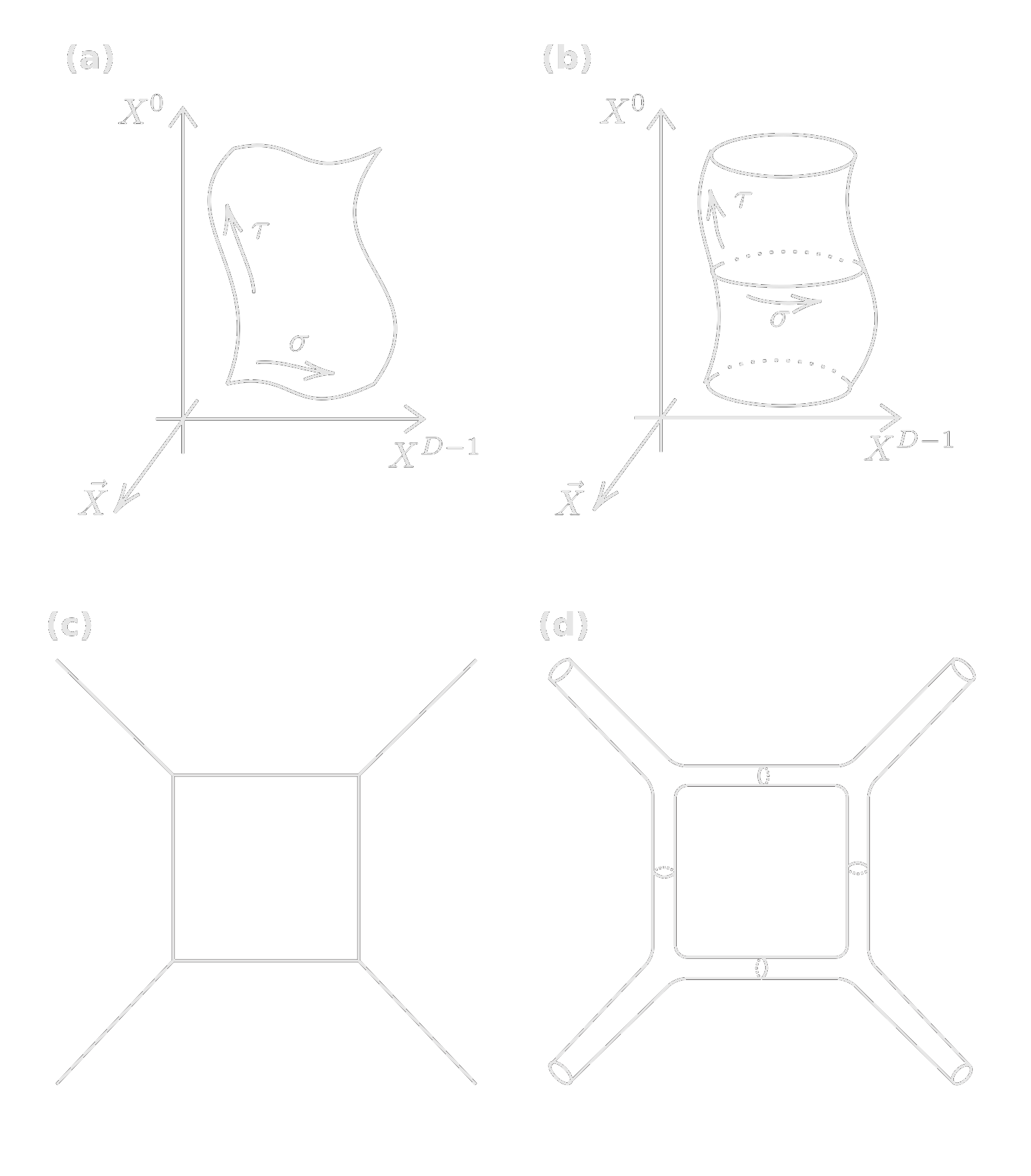
(a) An open string sweeps out a strip-like worldsheet. (b) A closed string sweeps out a tube-like one, both parametrized by $(\sigma, \tau)$. (c) In the point-particle picture, a UV divergence appears when propagators meet at a single vertex. (d) The analogous string diagram has no such point-like vertex — the interaction is smeared over a smooth worldsheet. Figure from (Nawata, Tao & Yokoyama, 2022).
The basic idea. Every elementary particle is a vibrational mode of one and the same kind of string — different notes on one instrument, where the note fixes the mass and charge of the particle you observe. Strings come in two flavors, open (with ends) and closed (loops), and a string’s trajectory through spacetime is a two-dimensional surface called the worldsheet, as in (a) and (b) above.
How small is a string? Probably around $10^{-33}\,\text{cm}$, the Planck length. For scale: a string would be to a proton roughly what a proton is to a city a hundred kilometres across. In the most optimistic scenarios it could be as large as $10^{-17}\,\text{cm}$ — still ten thousand times smaller than a proton, and still far beyond any collider.
Why the theory has no adjustable knobs
The only dimensionful parameter is $\alpha’ = \ell_s^2$, and since it merely sets the unit of length, the theory has no free dimensionless parameters at all. Contrast this with the Standard Model’s roughly nineteen.
Even the string coupling isn’t one: $g_s = e^{\langle\Phi\rangle}$ is the expectation value of the dilaton, a dynamical field, so it’s determined by the vacuum rather than chosen by hand. This rigidity cuts both ways — it’s why consistency alone fixes so much, and why the freedom reappears instead in the choice of compactification.
One caveat on the slogan above: once branes enter, “everything is a string mode” needs qualifying, since branes are non-perturbative objects rather than string excitations.
The spectrum. Quantizing the string gives a tower of vibrational modes, and the lightest ones are the particles we could hope to see. Crucially, a massless spin-2 state appears automatically among them — the graviton falls out for free rather than being put in by hand. This is perhaps the single most important fact about the theory: you cannot build a consistent string theory without gravity.
The mass formulas, and the tachyon
The massless sector contains a spin-1 gauge boson from the open string and a spin-2 field $g_{\mu\nu}$ from the closed string. The massive levels follow
\[M^2 = \frac{1}{\alpha'}(N-1) \quad \text{(open bosonic)}, \qquad M^2 = \frac{4}{\alpha'}(N-1) \quad \text{(closed bosonic)},\]where $N$ counts oscillator excitations. The closed-string formula carries the level-matching constraint $N = \tilde{N}$ between left- and right-moving modes.
The $N = 0$ ground state has $M^2 < 0$ — a tachyon, signaling that the purely bosonic string (consistent only in $D = 26$) sits at an unstable point and cannot be the final answer. Superstrings fix this.
No ultraviolet divergences. In field theory, infinities come from diagrams where propagators collide at a point-like vertex, as in (c). A worldsheet has no such vertex — interactions are smeared over a smooth surface, as in (d). For closed strings the statement can be made sharp: modular invariance restricts the integral to a region that excludes the dangerous configurations altogether. String amplitudes are UV-finite order by order, which is a stronger statement than “renormalizable.”
Making it consistent: superstrings. Giving the worldsheet fermionic degrees of freedom and imposing the GSO projection removes the tachyon, produces spacetime supersymmetry, and forces the theory into exactly ten dimensions — not as an assumption, but as the only value for which the quantum theory is consistent. There are precisely five consistent superstring theories there: Type I, Type IIA, Type IIB, and the two heterotic theories, $SO(32)$ and $E_8 \times E_8$, all related as limits of eleven-dimensional M-theory.
Where the branes live
D$p$-branes appear throughout, with $p$ the number of spatial dimensions the brane extends along: IIA carries even $p$, IIB odd $p$, and Type I has D1- and D5-branes. Open strings end on them, which is what makes them the natural home for gauge theories.
Far below the string scale, each theory reduces to some flavor of supergravity — the low-energy effective description in which the massive string tower has been integrated out.
Getting down to four dimensions. Ten dimensions obviously isn’t what we observe. The standard move is Kaluza-Klein compactification: curl six of the spatial dimensions into a shape small enough that nothing can resolve it.
The usual picture is a garden hose. From across the field it looks like a line — one dimension, position along the hose. Walk up to it and there’s a second dimension you had missed: a circle running around the surface at every point. An ant on the hose has two directions to walk; from a distance, one of them is invisible. String theory proposes that our four-dimensional world is the view from across the field, and that a six-dimensional shape sits at every point of it, curled up below $10^{-17}\,\text{cm}$.
The shape matters enormously. Its geometry determines which particles exist in the four-dimensional world, what masses they have, and which forces act on them. Different shapes give different universes — which is precisely the freedom that generates the landscape.
Calabi-Yau, and a common overstatement
It’s often said that consistency forces the internal manifold $M$ to be a Calabi-Yau. That’s not quite right. What forces it is the additional demand of unbroken $\mathcal{N} = 1$ supersymmetry in four dimensions with vanishing background flux (Candelas, Horowitz, Strominger & Witten, 1985).
Turn on flux and the internal manifold is generically non-Calabi-Yau, carrying $SU(3)$ structure rather than $SU(3)$ holonomy. That generalization is what makes moduli stabilization possible — and, unavoidably, what makes the landscape so large.
None of this is a claim that string theory is correct in the sense of being confirmed by experiment; that is a separate and much harder question, and the honest answer today is that we don’t know. But as a framework that has repeatedly forced deeper insight into quantum gravity, generated an enormous variety of physical theories, supplied working tools for strongly coupled systems, and quietly rewritten parts of geometry along the way, it earns its place as something worth years of one’s life. That, more than any single result, is my answer to “why string theory?”
This post originally grew out of the Fudan lectures, which I’d recommend as a concise starting point. All figures are reproduced from it for illustrative, non-commercial use. I also keep a longer list of study resources on my Resources page, and in the references below.
A note on process: I drafted this post myself and then worked through it with Claude (Anthropic), which helped me restructure several explanations, and track down references I’d left implicit. The views, the choice of what to include, and any remaining errors are mine.
Glossary
For the terms that recur above, in rough order of appearance.
| Term | Meaning |
|---|---|
| Quantum field theory | The framework behind the Standard Model: particles are excitations of fields filling space. |
| Effective theory | A description valid only below some energy, agnostic about what lies above it. |
| Ultraviolet / infrared | Short distances and high energies / long distances and low energies. |
| Renormalizable | Needing only finitely many measured inputs to make predictions at all energies. |
| Perturbation theory | Solving by successive small corrections to a simple starting point; fails when interactions are strong. |
| Amplitude | The object encoding the probability for particles going in to come out as something else. |
| Worldsheet | The two-dimensional surface a string sweeps out as it moves through spacetime. |
| Graviton | The quantum of the gravitational field; necessarily massless with spin 2. |
| Tachyon | A state of imaginary mass, signaling the theory sits at an unstable point. |
| Anomaly | A symmetry of the classical theory destroyed by quantum effects; fatal for gauge symmetry. |
| Supersymmetry | A symmetry relating force-carrying and matter particles; not yet observed in nature. |
| D-brane | An extended object on which open strings end; carries charge and has its own dynamics. |
| Compactification | Curling up extra dimensions so small that the world looks lower-dimensional. |
| Calabi-Yau manifold | The class of six-dimensional shapes preserving minimal supersymmetry when curled up. |
| Moduli | Parameters describing the size and shape of the compactified dimensions. |
| Duality | An exact equivalence between two theories that look completely different. |
| AdS/CFT | The duality between gravity in a bounded spacetime and a gravity-free theory on its boundary. |
| Entanglement entropy | A measure of how much one part of a quantum system knows about the rest. |
| BPS / extremal | Specially symmetric states whose properties are protected against changes in coupling. |
| The landscape | The vast set of possible four-dimensional vacua string theory admits. |
References
Quantum gravity and black holes
- ’t Hooft, G., and M. Veltman. “One-loop divergencies in the theory of gravitation.” Ann. Inst. H. Poincaré A 20 (1974): 69–94.
- Goroff, Marc H., and Augusto Sagnotti. “The ultraviolet behavior of Einstein gravity.” Nucl. Phys. B 266 (1986): 709–736.
- Donoghue, John F. “General relativity as an effective field theory: the leading quantum corrections.” Phys. Rev. D 50 (1994): 3874–3888.
- Witten, Edward. “Superstring perturbation theory revisited.” arXiv:1209.5461 (2012).
- Sen, Ashoke. “Ultraviolet and infrared divergences in superstring theory.” arXiv:1512.00026 (2015).
- Bekenstein, Jacob D. “Black holes and entropy.” Phys. Rev. D 7 (1973): 2333–2346.
- Bardeen, James M., Brandon Carter, and S. W. Hawking. “The four laws of black hole mechanics.” Commun. Math. Phys. 31 (1973): 161–170.
- Hawking, S. W. “Particle creation by black holes.” Commun. Math. Phys. 43 (1975): 199–220.
- Hawking, S. W. “Breakdown of predictability in gravitational collapse.” Phys. Rev. D 14 (1976): 2460–2473.
- Page, Don N. “Information in black hole radiation.” Phys. Rev. Lett. 71 (1993): 3743–3746.
- Strominger, Andrew, and Cumrun Vafa. “Microscopic origin of the Bekenstein-Hawking entropy.” Phys. Lett. B 379 (1996): 99–104.
- Penington, Geoffrey. “Entanglement wedge reconstruction and the information paradox.” JHEP 09 (2020): 002.
- Almheiri, Ahmed, Netta Engelhardt, Donald Marolf, and Henry Maxfield. “The entropy of bulk quantum fields and the entanglement wedge of an evaporating black hole.” JHEP 12 (2019): 063.
Holography
- ’t Hooft, Gerard. “Dimensional reduction in quantum gravity.” arXiv:gr-qc/9310026 (1993).
- Susskind, Leonard. “The world as a hologram.” J. Math. Phys. 36 (1995): 6377–6396.
- Maldacena, Juan. “The large N limit of superconformal field theories and supergravity.” Adv. Theor. Math. Phys. 2 (1998): 231–252.
- Gubser, S. S., I. R. Klebanov, and A. M. Polyakov. “Gauge theory correlators from non-critical string theory.” Phys. Lett. B 428 (1998): 105–114.
- Witten, Edward. “Anti de Sitter space and holography.” Adv. Theor. Math. Phys. 2 (1998): 253–291.
- Ryu, Shinsei, and Tadashi Takayanagi. “Holographic derivation of entanglement entropy from AdS/CFT.” Phys. Rev. Lett. 96 (2006): 181602.
- Hubeny, Veronika E., Mukund Rangamani, and Tadashi Takayanagi. “A covariant holographic entanglement entropy proposal.” JHEP 07 (2007): 062.
- Van Raamsdonk, Mark. “Building up spacetime with quantum entanglement.” Gen. Rel. Grav. 42 (2010): 2323–2329.
- Kovtun, P. K., D. T. Son, and A. O. Starinets. “Viscosity in strongly interacting quantum field theories from black hole physics.” Phys. Rev. Lett. 94 (2005): 111601.
- Hartnoll, Sean A., Christopher P. Herzog, and Gary T. Horowitz. “Building a holographic superconductor.” Phys. Rev. Lett. 101 (2008): 031601.
Origins and history
- Veneziano, G. “Construction of a crossing-symmetric, Regge-behaved amplitude for linearly rising trajectories.” Nuovo Cim. A 57 (1968): 190–197.
- Susskind, Leonard. “Structure of hadrons implied by duality.” Phys. Rev. D 1 (1970): 1182–1186. The string interpretation was reached independently by Y. Nambu and H. B. Nielsen in 1969–70, both in conference proceedings.
- Ramond, P. “Dual theory for free fermions.” Phys. Rev. D 3 (1971): 2415–2418.
- Neveu, A., and J. H. Schwarz. “Factorizable dual model of pions.” Nucl. Phys. B 31 (1971): 86–112.
- Scherk, Joël, and John H. Schwarz. “Dual models for non-hadrons.” Nucl. Phys. B 81 (1974): 118–144.
- Yoneya, T. “Connection of dual models to electrodynamics and gravidynamics.” Prog. Theor. Phys. 51 (1974): 1907–1920.
- Gliozzi, F., J. Scherk, and D. Olive. “Supersymmetry, supergravity theories and the dual spinor model.” Nucl. Phys. B 122 (1977): 253–290.
- Green, Michael B., and John H. Schwarz. “Anomaly cancellations in supersymmetric D=10 gauge theory and superstring theory.” Phys. Lett. B 149 (1984): 117–122.
- Gross, David J., Jeffrey A. Harvey, Emil Martinec, and Ryan Rohm. “Heterotic string.” Phys. Rev. Lett. 54 (1985): 502–505.
- Candelas, P., G. T. Horowitz, A. Strominger, and E. Witten. “Vacuum configurations for superstrings.” Nucl. Phys. B 258 (1985): 46–74.
Dualities, branes, and M-theory
- Hull, C. M., and P. K. Townsend. “Unity of superstring dualities.” Nucl. Phys. B 438 (1995): 109–137.
- Townsend, P. K. “The eleven-dimensional supermembrane revisited.” Phys. Lett. B 350 (1995): 184–187.
- Witten, Edward. “String theory dynamics in various dimensions.” Nucl. Phys. B 443 (1995): 85–126.
- Witten, Edward. “Some comments on string dynamics.” arXiv:hep-th/9507121 (1995).
- Polchinski, Joseph. “Dirichlet branes and Ramond-Ramond charges.” Phys. Rev. Lett. 75 (1995): 4724–4727.
- Bagger, Jonathan, and Neil Lambert. “Modeling multiple M2’s.” Phys. Rev. D 75 (2007): 045020.
- Gustavsson, Andreas. “Algebraic structures on parallel M2-branes.” Nucl. Phys. B 811 (2009): 66–76.
- Aharony, Ofer, Oren Bergman, Daniel Louis Jafferis, and Juan Maldacena. “N=6 superconformal Chern-Simons-matter theories, M2-branes and their gravity duals.” JHEP 10 (2008): 091.
- Gaiotto, Davide. “N=2 dualities.” JHEP 08 (2012): 034.
Mathematics
- Greene, Brian R., and M. R. Plesser. “Duality in Calabi-Yau moduli space.” Nucl. Phys. B 338 (1990): 15–37.
- Candelas, Philip, Xenia C. de la Ossa, Paul S. Green, and Linda Parkes. “A pair of Calabi-Yau manifolds as an exactly soluble superconformal theory.” Nucl. Phys. B 359 (1991): 21–74.
- Kontsevich, Maxim. “Homological algebra of mirror symmetry.” arXiv:alg-geom/9411018 (1994).
- Strominger, Andrew, Shing-Tung Yau, and Eric Zaslow. “Mirror symmetry is T-duality.” Nucl. Phys. B 479 (1996): 243–259.
- Seiberg, N., and E. Witten. “Electric-magnetic duality, monopole condensation, and confinement in N=2 supersymmetric Yang-Mills theory.” Nucl. Phys. B 426 (1994): 19–52.
- Witten, Edward. “Monopoles and four-manifolds.” Math. Res. Lett. 1 (1994): 769–796.
- Kapustin, Anton, and Edward Witten. “Electric-magnetic duality and the geometric Langlands program.” Commun. Num. Theor. Phys. 1 (2007): 1–236.
- Alday, Luis F., Davide Gaiotto, and Yuji Tachikawa. “Liouville correlation functions from four-dimensional gauge theories.” Lett. Math. Phys. 91 (2010): 167–197.
Landscape and swampland
- Giddings, Steven B., Shamit Kachru, and Joseph Polchinski. “Hierarchies from fluxes in string compactifications.” Phys. Rev. D 66 (2002): 106006.
- Kachru, Shamit, Renata Kallosh, Andrei Linde, and Sandip P. Trivedi. “de Sitter vacua in string theory.” Phys. Rev. D 68 (2003): 046005.
- Douglas, Michael R. “The statistics of string/M theory vacua.” JHEP 05 (2003): 046.
- Vafa, Cumrun. “The string landscape and the swampland.” arXiv:hep-th/0509212 (2005).
- Ooguri, Hirosi, and Cumrun Vafa. “On the geometry of the string landscape and the swampland.” Nucl. Phys. B 766 (2007): 21–33.
Books and lecture notes
- Green, Michael B., John H. Schwarz, and Edward Witten. Superstring Theory, Vols. 1 & 2. Cambridge University Press, 1987.
- Polchinski, Joseph. String Theory, Vols. 1 & 2. Cambridge University Press, 1998.
- Zwiebach, Barton. A First Course in String Theory. Cambridge University Press, 2004 (2nd ed. 2009).
- Becker, Katrin, Melanie Becker, and John H. Schwarz. String Theory and M-Theory: A Modern Introduction. Cambridge University Press, 2006.
- Kiritsis, Elias. String Theory in a Nutshell. Princeton University Press, 2007 (2nd ed. 2019).
- Blumenhagen, Ralph, Dieter Lüst, and Stefan Theisen. Basic Concepts of String Theory. Springer, 2013.
- Tong, David. “Lectures on string theory.” arXiv:0908.0333 (2009).
- Nawata, Satoshi, Runkai Tao, and Daisuke Yokoyama. “Fudan lectures on string theory.” arXiv:2208.05179 (2022).